Emergency Medicine Clerkship Guide
|
By Jacob Kocsis, Class of 2012,
BHSc.PA, BHSc.Hon. CCPA in Emergency Medicine. Edited by Anne Dang, Class of 2011, CCPA in Orthopaedic Surgery |
N.B. for pediatric emergency medicine please see my pediatric specific guide
|
CONTENTS
- What is emergency medicine?
- What to wear
- What to bring
- Sections of the ER
- What you'll learn during the rotation
- Learning Objectives: How to work up, Management Algorithms, Clinical Skills
- Sample ED Note
- Typical Schedule: typical shift, calling consultants, professionalism, teamwork
- Tidbits and Pearls
- Useful Books and Resources (Textbooks, Apps)
What is Emergency Medicine (EM)?
EM is a population and hospital-based specialty in which clinicians care for patients with acute conditions, sometimes life-threatening, that require immediate intervention.
What to Wear:
You never know when you might get dirty in the emergency department (ED) so scrubs are, in my opinion, the way to go. That said, you will see clinicians dressed in everything from jeans and a t-shirt to a shirt and tie in the ED. Attire tends to be ED and zone-specific (some EDs are segregated into zones based on patient acuity).
|
What to Bring:
|
Sections of the ER
Waiting area: where patients tend to sit waiting to be called after seeing triage and before being seen/called by you or a nurse who will put them in a room
Triage: usually run by an experienced nurse, this is where patients present to and where the triage nurse will make an initial assessment and assign a CTAS score and then will decide what part of the ED they should be in and how soon they should be seen. Occasionally a medical provider (PA, NP, MD, DO, MBBS, Etc., Etc.) may see patients here or be called here.
Zones: minor zone, major zone, rapid assessment zone, trauma room, and resuscitation room are all possible ways to zone-off an ED. The titles are fairly self-descriptive.
Supply Rooms: where you will find supplies for procedures
Isolation room: often closed-off to prevent spread of infection
Radiography/Xray room: where patients get plain films done after you order them
Nursing station: often set up as a pod in the middle of a zone; this is where nurses do paperwork, computer work, and monitor their patients from when not at the bedside. Administrative clerks also often sit and work here.
Charting room: area for medical staff (that’s you) to do paperwork, computer work, and discuss cases with your preceptor. Hopefully you will have PACS access here to view imaging.
Lounge/Lunch Area/Lockers: hopefully you will have access to this.
Triage: usually run by an experienced nurse, this is where patients present to and where the triage nurse will make an initial assessment and assign a CTAS score and then will decide what part of the ED they should be in and how soon they should be seen. Occasionally a medical provider (PA, NP, MD, DO, MBBS, Etc., Etc.) may see patients here or be called here.
Zones: minor zone, major zone, rapid assessment zone, trauma room, and resuscitation room are all possible ways to zone-off an ED. The titles are fairly self-descriptive.
Supply Rooms: where you will find supplies for procedures
Isolation room: often closed-off to prevent spread of infection
Radiography/Xray room: where patients get plain films done after you order them
Nursing station: often set up as a pod in the middle of a zone; this is where nurses do paperwork, computer work, and monitor their patients from when not at the bedside. Administrative clerks also often sit and work here.
Charting room: area for medical staff (that’s you) to do paperwork, computer work, and discuss cases with your preceptor. Hopefully you will have PACS access here to view imaging.
Lounge/Lunch Area/Lockers: hopefully you will have access to this.
As a PA clinical clerk your job will likely be to pick-up charts according to acuity (though sometimes patients are seen according to their time of time of arrival - if acuity is about the same between patients waiting to be seen, as is often the case in the minor zone). For what to do after picking-up the chart, see my “Tidbits and Pearls” section below.
A note of caution about the minor zone: most triage nurses I have worked with are very good, but even the best can be wrong at times. It happens to all of us. Just because you are in the minor zone seeing a “minor” patient who has been triaged as a CTAS 4 or 5 does NOT mean that they might not actually be a 1, 2, or 3. Anybody who has worked in emergency medicine long enough will tell you about minor zone/fast-track disasters where someone was triaged to minor for MSK shoulder pain when in fact they were having a STEMI and nobody noticed until they were seen, hours later, by the medical provider. It happens, so keep your differential wide and remember that, even in the minor zone, your job is to rule out that which may kill the patient. Only once you have considered/thought about those deadly things and ruled them out should you start to focus in your differential diagnosis. Especially at the level of a clinical clerk, PA or MD, you must take care to keep a wide differential and always question yourself. You will likely still miss stuff, but hopefully a lot less this way.
What you'll learn during the rotation:
- The ED is great for learners because of the high volume of patients and the wide range of presentations and issues. This is a good opportunity to polish your history and physical exam skills, your ability to quickly develop good differential diagnoses, and to learn the work-up and management of common emergency problems such as chest pain, abdominal pain, and Acute Coronary Syndrome (ACS). You will also, hopefully, have a chance to develop procedural skills in suturing/laceration repair, casting/splinting, foreign body removal, lumbar punctures (LPs), and things such as reading plain film x-rays, interpreting EKGS, CPR, conscious sedation, slit lamp exam, and airway management.
- The knowledge and skills developed in the ED will be directly transferable and useful in all other rotations (e.g. Family Medicine, Internal Medicine, Geriatrics, Orthopaedics, Etc., Etc.)
Learning Objectives
How to Work Up:
|
|
|
|
This list is certainly not exhaustive. For a more complete list, see Tintinalli’s Emergency Medicine Table of Contents: http://accessmedicine.com/resourceTOC.aspx?resourceID=40
Management Algorithms (*often hospital specific)
|
|
* N.B. Algorithms should not be followed blindly. There is a reason you have gone to school and spent thousands of hours studying medicine; because if things were as simple as following algorithms then patients wouldn't need clinicians, they could just use computers. Use them as a guide and a starting point but be able to create management plans based on your knowledge and skills.
Clinical Skills
|
|
- Case Presentations: In presenting the patient to your preceptor, find out how they liked to be presented to. Every preceptor is a bit different in this respect and in emerg where you often work with different preceptors each shift, this can be challenging and a good opportunity to develop strength in your presentation skills. But in all cases make sure that YOUR thought process is clear because then at least your preceptor can help you learn from what you are doing wrong and right. Be sure to see our resources on making case presentations.
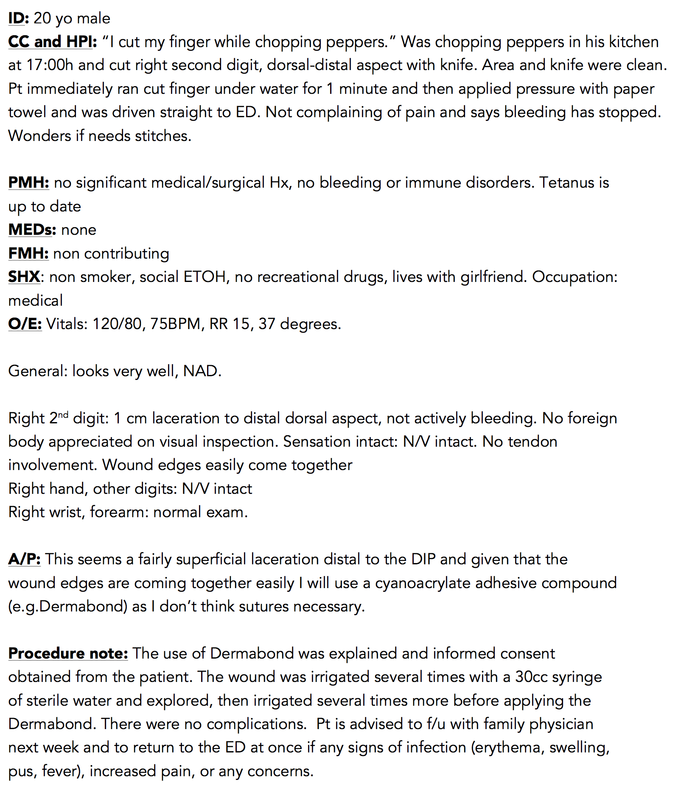
Sample ED Note
Typical Schedule
- A Typical Shift: A typical shift might be scheduled for 8 hours but I would often end-up working 10-12 just because I didn’t like handing off unfinished work to the next shift. I would see a few patients, write up the A/P, discuss them with my staff physician or PA, put the orders I had written into the order box for the nurses, discuss the care of the pts with the nurses, explain to the pts what we are thinking and what our plan is, perform various procedures, and give lots of discharge instructions.
- Calling Consultants in the ED: For some pts, usually in the major zones, I would call consultants such as Internal Medicine, General Surgery, OB/Gyn, Etc., Etc. When calling a consultant, be polite, courteous, introduce yourself and your title (Hi, my name is John Smith I am a PA clinical clerk working with Dr. Bob in the ED, we have a patient we would like to tell you about). Often when you are speaking to a consultant they are an overworked resident and will appreciate a nice person who tells them what they need to do. Presenting the patient to the consultant is like presenting to your staff only you should also make it obvious why you are asking that particular consultant to see the patient and should ask them if there is anything they would like done before they come to the ED.
- Be Professional: Sometimes during a shift we would have traumas or codes and I would get to help run a code or manage an airway, intubate, place a chest tube, do chest compressions, place central lines, or other similar things that you are probably thinking are the exciting part of practicing emergency medicine. That said, when you do get the opportunity to do these things, even though you might be excited, please remember that this is someone’s loved one you are working on and that the family/friends may be watching/listening to you. High-fiving your team-mate because you placed the ETT is not the best idea and certainly not professional (and, yes, I have seen someone do that, in front of the patient’s wife!)
- Team work: Emergency Medicine is a team sport. Each patient will have a nurse and a staff medical provider. Typically there will also be a learner (in a teaching hospital) such as yourself, a more senior learner (a resident) and then the staff physician or PA. There are also social workers, respiratory therapists, CCAC coordinators and a whole bunch of other professionals that will be involved in a pt’s care.
Tidbits and Pearls
What I did as a clerk in Emergency:
- I would grab the chart and take note of the chief complaint and the vitals from triage. Then I would write-out my differential diagnosis first thinking of the most dangerous things this could be (rule out what will kill your patient first) and then the most common and then less likely. I would then go see the patient, introducing myself as “Hi, my name is Jacob Kocsis, I am a PA student here working with Dr. So-and-so. I have already read a bit about you but I like to hear from the patient directly so please, tell me; what brings you in?.”
- After taking a thorough history I would perform a physical guided by my history. By this point I was usually fairly certain of what this could be and how we were going to proceed and the physical rarely changed that. I would then tell the patient I will speak to my preceptor and we will come back together. I asked them if they had any questions and I would answer them. Then I would write-out my assessment and plan and find my precepting physician to present to them (though sometimes I would pick up multiple patients at once and then present; this depends on who your preceptor is and how they want things done—ask them!).
- If there are procedures to do and you want to learn do not be shy about asking. Be a self-promoter without being annoying or pushy. This is a fine line to walk so be careful and use your social intuition and emotional intelligence.
- The nurses in the emerg, like anywhere, can make or break you. Be friendly and professional! And have fun! It is a rewarding specialty that offers a variety of experiences where no two shifts are the same and you never know what you are going to see.
Useful Books and Resources
Textbooks/Handbooks |
Smartphone Apps
|
ABOUTMPASA is the Student Association for McMaster's Physician Assistant Education Program in
Hamilton, Ontario, Canada. |
|
LINKS |
Disclaimer: The opinions expressed on this website are those of the author, and they do not reflect in any way those of the institutions to which they are affiliated.
